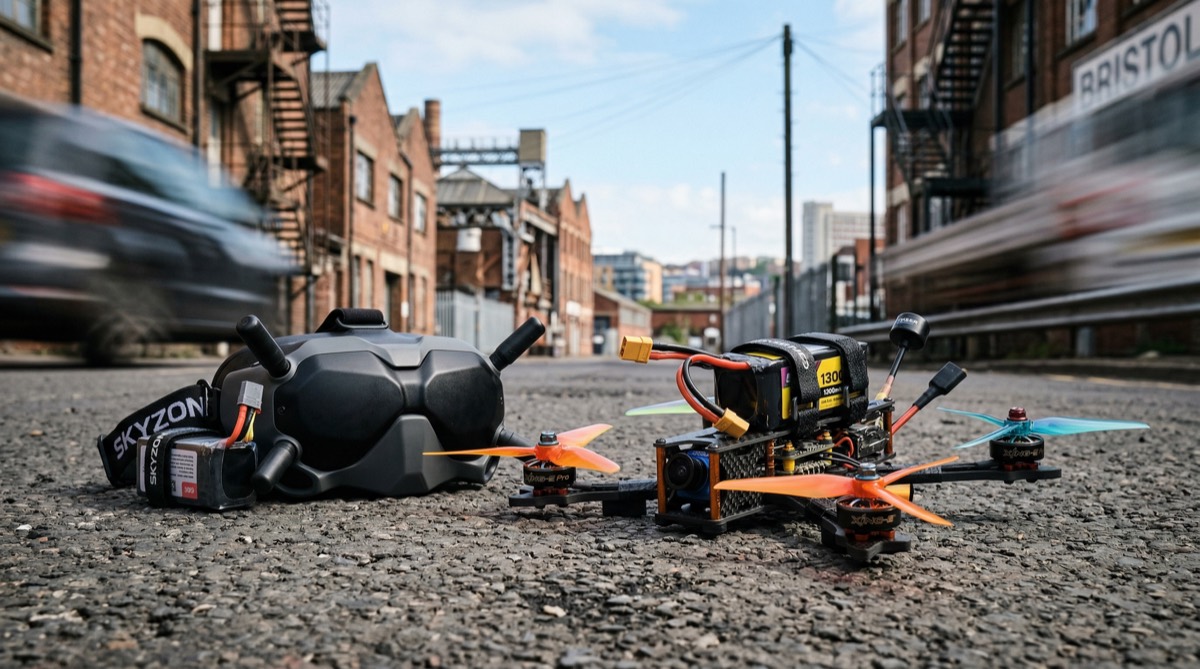
FPV drone footage has become one of the most requested shots in commercial video over the last few years. When it's done well, it's genuinely unlike anything else available. When it's done badly — and it often is — it looks chaotic and amateur. Here's an honest breakdown of what FPV is, what it's actually good for, and what you need to know before putting it in your brief.
What is FPV drone filming?
FPV stands for First-Person View. The pilot wears a headset and flies entirely from the drone's camera perspective rather than looking at the drone in the sky. This allows for a fundamentally different type of movement — low, fast, through tight spaces, with dynamic arcs and speed changes that a stabilised camera drone simply cannot do.
Standard drones like the DJI Mavic 4 Pro produce smooth, cinematic aerial footage. FPV produces immersive, kinetic footage. They're complementary tools, not alternatives. The best aerial shoots use both.
What is FPV good for?
- Product reveals. A fast FPV arc around a product or vehicle creates energy and scale. Common in automotive, tech, and lifestyle content.
- Interior flythroughs. FPV can fly through doors, down corridors, and through architectural spaces in a single continuous shot. Useful for property, hospitality, and architectural work.
- Chase sequences. Following a vehicle, athlete, or subject at speed with a drone that can keep up. Motorbike content is a natural fit.
- Location reveals. Flying through a landscape or into a space in a way that builds anticipation. Works particularly well as an opening shot.
- High-energy brand content. If the brand has pace, dynamism, or physicality, FPV can carry that tonally in a way that no other aerial system can.
Two FPV systems for different briefs
I fly two FPV rigs. The first is an off-the-shelf system — reliable, well-understood, and right for most commercial FPV briefs. The second is a custom-built rig I've spec'd for performance in more demanding conditions: more power, a different weight profile, and more flexibility in how it handles complex sequences.
Most clients don't need to know which rig we're using. What matters is that the right tool is available for the shot, rather than being constrained to one system.
FPV in Bristol: practical considerations
Bristol has a mix of good and challenging FPV environments. The city centre and harbour are densely populated, which adds regulatory complexity for any drone operation. For urban Bristol FPV, the sub-250g rig significantly reduces the restriction footprint and is my first choice for city locations.
Outside the city centre, Bristol and the surrounding area offer good FPV locations — the Downs, industrial estates, open countryside to the north and east, and the gorge at Clifton for dramatic natural framing. The key is planning. FPV shots require location assessment, risk assessment, and in some cases airspace authorisation. I handle all of that as part of pre-production.
How to include FPV in a brief
Don't brief FPV as "I want some FPV shots." Brief the content: what you're filming, what you want the viewer to feel, and what the shots need to achieve. From that I can tell you whether FPV is the right tool and what's achievable in the time available.
FPV takes longer per shot than standard drone work. A five-second FPV move might take 20 minutes of flying to get right. That's not inefficiency — that's the nature of the tool. Budget accordingly, or let me know if time is tight and I can advise on a shot list that's realistic for the day.
For FPV work as part of a larger production in Bristol, Singularity Film can coordinate multi-system shoots with full crew. For FPV as part of a standard commercial day rate, get in touch.